Showing posts with label team mauswagong mirangan. Show all posts

Thursday, April 2, 2015

Human Waste Disposal Impact on Health


During the primary survey conducted last October 2011, data showed that only 47% households have access to sanitary toilet facilities. The following reasons have been revealed during the initial assessment of households:
1.      Lack of awareness on effects of unsanitary toilet facilities 
2.      Inadequate communication strategies to promote use of sanitary toilet facilities
3.      Lack of programs targeting toilet sanitation
4.      Lack of political will to address issues on sanitation
5.      Cultural barriers continue to exist in 35% of the households in the community

In collaboration with identified key persons from the community, the team was able to formulate a comprehensive health plan with the objective of increasing the number of households with access to sanitary toilet facilities from 47% to 75% by the year 2015 consistent with Millenium Development Goal which targets to halve the proportion of people without sustainable access to sanitation by 2015.

Sanitation is defined as the safe disposal of human excreta and associate hygiene promotion. A safe toilet accompanied by handwashing with soap provides an effective barrier to transmission of diseases.

Each of the following sanitation facility type is considered basic sanitation for monitoring progress toward household sanitation targets.

·         If the facility is shared among no more than 5 families or 30 persons, whichever is fewer and if the users know each other

·         A pit latrine with a superstructure and a platform or squatting slab constructed of durable material including pour-flush latrines, ventilation improved pit latrines (VIP), pit latrine with slab
·         A flush toilet connected to a septic tank, other depository or a sewer


PROPOSED SOLUTIONS
           
Toilet adoption comes from providing the appropriate toilet design, nurturing community involvement and ownership of the problem, encouraging collaborations with the local leaders and stakeholders from the community and more importantly, understanding people’s ideas and values around sanitation. (Devine, 2009)

With this in mind, conceptualization of strategies for sustainable sanitation was created, which were the guiding principles of this project.

Breaking the Cycle of Cultural Barriers:
·         Identifying cultural practices: assessment of cultural influences on toilet adoption
·         Bridging leadership training with local leaders through self-awareness leadership training (SALT)
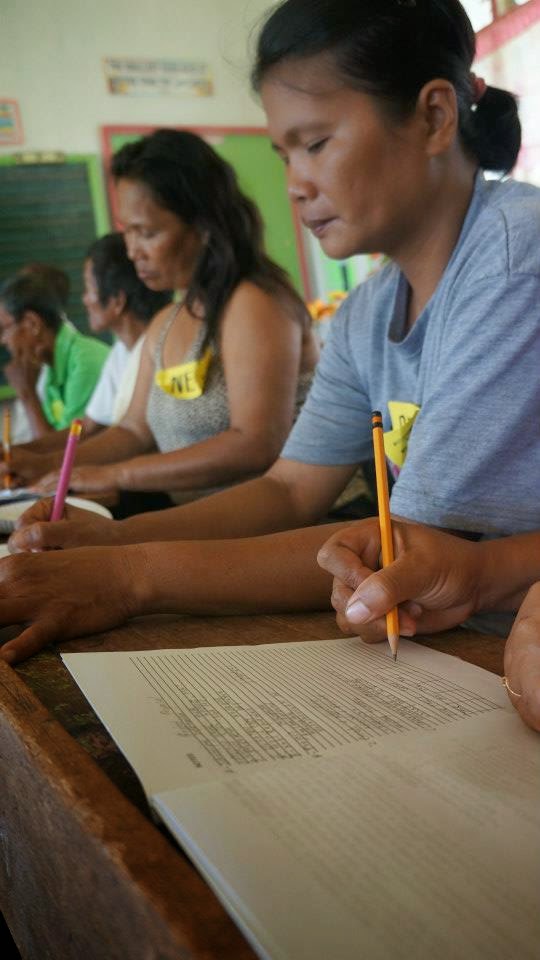
Mrs. Rubinos, then a 4Ps Parent Leader and Mrs. Ganob, Barangay Health Worker, taking notes during the leadership training


Orientation of Identified Key Persons from the community during a Communication Exercise

Team Mauswagong Mirangan attempting to reach the remote area of the barangay for primary health survey, October 2011

Primary Health Survey with Mrs. Silao, Barangay Nutrition Scholar, and members of the barangay council and health team

BNS accompanies Medical Student during the survey activities


Child Education: (children as promoters of good hygiene practices at home)
·         Launching of Global Hand Washing Day: Health education on hand washing
·         Stage Play: “Diarrhea Monster”

A shot taken during the play entitled Diarrhea Monster


Diarrhea takes the life of thousands of children annually. Increasing awareness of its prevention can make a difference in the lives of these children.


Global Handwashing Day celebration, October 2014


Handwashing Promotion during Global Handwashing Day Celebration, October 2014


Global Handwashing Day celebration, October 2012

Toilet Construction
·         Engaged social contract (Goal: One Toilet, One Household)
·         Solicit Sanitary Inspector advice on toilet construction
·         Construction design - culturally appropriate
·         Construction Phase –Bayanihan approach: A Filipino value

Head of Household signing a written agreement to support sanitation campaign by agreeing to construct toilet facility for a safer, healthier community.

Mr. Albano, Sanitary Inspector talks about the importance of sanitary toilet facilities during a Family Development Seminar

Locally Available Materials used for construction of toilet facilities


Newly constructed toilet facility for sustainable sanitation


Pour-Flush Toilets or water-seal type of toilets with less water required for flushing help increase toilet adoption in communities with problematic water supply


Toilet Construction at Purok 3


Monitoring
·         Establish Guidelines for Assessing Toilet Sanitation

Sustainable Sanitation
·         Establish a sanitation surveillance team
·         Creation of Local Ordinances to promote use of sanitary toilet facilities

Fostering political will through creation of written policies


Involvement of the stakeholders from the community proved to be an essential step towards achieving the goal of increasing percentage of households with access to basic sanitation

Monitoring of household's access to basic sanitation using a Sustainable Sanitation Criteria


Sanitation Surveillance Team in action, March 2013


SUSTAINABILITY
            Local leadership training of key persons identified provided an avenue for potentials to be realized and fresh ideas to be explored. Core group members were given the opportunity to exercise their leadership skills when the medical students gave them full responsibility in organizing events in the community. Action plans discussed during the previous years included plans for health education activities and monitoring of target households, these were implemented according to the pace set by the core group members. Their decision-making skills have been honed by years of experience in the community and their local influence has been beneficial in a multitude of sanitation campaigns and health promotion activities, proving that this unit can help mobilize the community even after the completion of the community immersion.
Construction of toilet facilities by target households in the beginning was difficult to promote, however, a steady increase in toilet adoption was observed during the years that followed. Nurturing community ownership of the problem coupled with behavior change communication proved to be effective in this community. As households began constructing their sanitary toilet facilities, they have assumed ownership of the program itself, placing value on hard work by peers and neighbors willing to help construct such a structure and encouraging other neighbors to do the same.
Written policies and regulations mandated by the legislative body of the community was the final step in the programs for toilet sanitation in hopes of reinforcing a sustainable sanitation program implemented in the community.


From 2011 – 2015 there have been changes in the behavior of the residents at Barangay Mirangan when it comes to sanitation. As shown in the figure above, the number of households with access to sanitary toilet facilities has steadily increased in the past three years, from 47 percent to 80 percent exceeding the hoped for target of 75 percent.
Nurturing community involvement and ownership of the problem, collaborations with the local leaders and stakeholders from the community and more importantly, understanding people’s ideas and values around sanitation helped in increasing toilet demand and therefore toilet adoption in the community.


Mauswagong Mirangan Through Alternative Income-Generating Projects

In the beginning, several causes were identified that caused the members of the community to have insufficient family income. These are: limited education, undiversified rural economy, and unfavorable climate for investment. Meetings were conducted to formulate solutions for this problems. Several government and non-government agencies were also visited to solicit solutions for the problems. With the help of the different agencies and of the members of the community, a plan of action was formulated. This plan action consisted of pre-operational, operational and post-operational stages. In the pre-operational phase, meetings were conducted to assess the available resources, inherent skills of the workers and the possible solutions that could be carried out. With the information gained, several actions were implemented to address each factor of concern. Since majority of the members of the community are farmers, coordination with the Department of Agriculture was done to solicit seminars on how to increase their production and to implore new seedlings to diversify their crop production. The relationship of the local farmer’s association and of the Department was also improved for easy access to any available programs in the future. But the farmers are just a part of the labor force of Mirangan, 85%; another are the housewives and out of school youth in the community, which compromise 41% of the work force. A significant number to consider. Hence, to insure the increase of their productivity, vocational seminars were conducted by the Kabasalan Institute of Technology. 27 housewives and 3 out of school youth attended the Bread and Pastry Production seminar and were certified as Bakers. While 50 out of school youth underwent the Shielded Metal Arc Welding vocational seminar and were certified as Welders. With this increase in their arsenal of skills, 3 of the certified bakers were employed at a local bakeshop, while 25 of the welders were enrolled in the Special Training for Employment Program of the provincial government to ensure their employment. The rest of the 27 bakers put of their own bakery in the barangay with the help of the barangay council and non-government agencies. This local bakery was named, Mirangan Bakery. It will be a venue where members of the community could practice their craft and earn for a living at the same time in the comfort of their own barangay. Hence, after the implementation of the different activities that were conducted to solve the problem of insufficient family income, the post-operation stage begins. In this stage, activities were conducted to guarantee the sustainability of the different projects. Management classes were conducted to the members of the bakery to increase their knowledge in handling their business. Barangay resolutions were also made to address any problems regarding the livelihood of the barangay. In general, the different factors were addressed and the different members of the work force were considered and given opportunities to be economically productive.


Meeting with Municipal Agriculturist for seminars regarding new farming methods


Procurement of seeds from Department of Agriculture Technician for Distribution

Conduct Self-Awareness Leadership Training Program for the Key Persons in the Community

Orientation on Organic Farming by Agriculture Technician

Bread and Pastry Production Vocational Seminar conducted by TESDA

Seminar conducted by Agriculture Technician on Vermiculture

Graduates of Shielded Metal Arc Welding availing of Start-up Kit from Provencial Government

Waste Segregation: For A Cleaner Barangay Mirangan

During the health survey conducted last October 2011, data revealed that among 292 target households in barangay Mirangan, 65% do not practice garbage segregation while only 35% are practicing segregation. For those who do not practice waste segregation, 58% burn their garbage and the remaining 42% practice open dumping of their waste.

On a deeper interview, it was noted that the people are unaware of the health consequences that improper solid waste management at the household level poses. The geographical location of the barangay served as a barrier in establishing “collect and transport” waste management plans. In addition, the road going to Barangay Mirangan is still underdeveloped. For this reason, the municipality continues to have a problem on the collection of the generated garbage in the area. 

In the initiation phase, focus was mainly on the assessment, presentation of the problem to various organizations at the barangay, generating ideas for solving the issues, coordinating with the proper agencies concerned and activities aimed at program planning. It was then followed by activities for the implementation of planned intervention by the community and medical students. 

Guided by the R.A 9003, solutions created by the community together with the medical students are the following:

·         Waste Management Plans were proposed in accordance with R.A. 9003 focusing on the 3R’s (Reduce, Reuse and Recycle).

·         Barangay waste management committee was formed from the core group as stipulated under R.A. 9003.

·         “Zero Basura” that gives emphasis on reduction of wastes being generated and reduction of wastes to be disposed through segregation at source was promoted through presented waste management scheme.
·         A series of health education on proper solid waste segregation at household level were conducted. Different population group were the target of education that includes mothers or representative head per households, youth and elementary students. Passive health information was also done through posters per purok and distribution of pamphlet per households.

  • Community involvement such as cleanup activity per week was applied and two pits per cluster of households for disposal of biodegradable and non-biodegradable wastes were constructed. At least 30 meters away from the water sources.

  • “Basura Patrol” was created. Every hamlet should have a group of people from the hamlet officers, core group members and youth volunteers responsible for the solid waste management to which they belong. Their function is to ascertain the maintenance of proper waste segregation and proper waste disposal within cluster of households.

  • Conducted a school campaign on proper solid waste management with the SK Officers and youth volunteers promoting proper garbage segregation and utilization of compost pit and recycling through information dissemination.

  • Ordinances and resolutions such as mandatory waste segregation, compost pit per households and no burning of rice hull were created to support the activity on garbage.
  • Lastly, program scheme was presented to the municipal level for approval, support and implementation.
The solution generated is perceived as acceptable and sustainable by the community. The present ordinance and resolution of the barangay shall be the base support of the activities promoting the proper solid waste management. The barangay waste management committee was formed, headed by present barangay council on environmental sanitation, Mr. Reneboy Samonte and former council on environmental sanitation, Mr. Ariel Oroc. This committee was given the function to monitor through the use of evaluation tool and submit a report on the activity of households every month during the first barangay session of the month. Under the mentioned committee, Basura Patrol, a sub-group, headed by hamlet leaders, was provided the responsibility to ascertain the function of the group per hamlet.


With these, an increased in number of households were noted over the years, from 102 (35%) during 2012, then 149 (51%) during 2013, to 188 (64%) on 2014.  The team Mauswagong Mirangan – medical students and community, therefore concludes that “Malinis Na Kapaligiran” has been achieved.


Discussing R.A. 9002 with the key persons in the community

Formation of Core Group Members

Christine Bersola-Babao's "Basura Monster", teaching kids the importance of Environmental Sanitation

Teaching Kids on Waste Segregation

Health Teaching Series during Family Development Sessions


Room-to-room visit for Sanitation Campaign Week at Mirangan Elementary School

Posters per CLARCS

Conducted Clean-Up Drive or  "Pahina"


Distribution of  informative pamphlets on Waste Segregation

Two-bins per CLARCS were also installed


Two-pits were created per cluster of households